Announcement

Collapse
No announcement yet.

Weight lifting, body building and carbs.

Collapse
X
 
  • Filter
  • Time
  • Show
Clear All
new posts

  • #16
    yep a small carbohydrate amount before the exercise as part of their meal sounds just like Atkins small amount of carbs at a meal. Your carb levels go up on Atkins according to the Doc if you engage in heavy exercise. What was your CCLL when you were lifting or did you not increase it accordingly? I was up to 110 when i was lifting heavy and doing HIIT
    It would be interesting to see if those test subjects had suffient body fat and exactly what they were eating as their diet.
    by the book atkinseer

    started 6/1/02 at 313
    goalie 5/04 at 167 with under 15% body fat ADBB Presidents exercise Challenge


    Comment


    • #17
      My lifts go better if I eat a small amount of carbs and no fat right around my workouts. Not stuffing myself, not overdoing it. Things like raw oats, whole grain bread, 1/2 a small sweet potato, etc. A TKD fits fine into the later stages of Atkins - you simply change the timing of your carb containing meals around your workouts.

      Currently I'm getting from 50 to 150 carbs a day depending on my lifting schedule. The higher numbers would be from the dextrose I take after a "hardgainer" full body workout. I've also dropped my fat percentages considerably and found that I lose better that way, since my body has already made the long term adaptations to better fat burning even without as much dietary fat. Can't say I[m enjoying my food as much, but it's something I needed to do to keep losing while adding carbs for lifting.

      Comment


      • #18
        You keep stressing the need for making more glycogen from carbs during workouts or muscles will be eatten for the glycogen to fuel them. While you are checking out those studies you might want to look at the pathway for producing the glycogen cause every possible method to produce it in the body is blocked during burning of it and its byproduct glucose. Our bodies can't possible generate any glycogen during muscle workouts no matter what you eat.

        here is the methods human bodies uses for creating glucose when the glucose levels are low and as you will see the least energy costly method is the glycerol from the fats and the amino acid one is the most costly

        here is all the pathways for the creation of glucose during exercise credit for this info goes to Fordham University in conjection with Biochemistry 460 at Arizona (Dr. Tischler)
        "Biochemistry" - Stryer (1995)
        Biochemistry 3033 at Florida International University (kind permission of Dr. Kelsey Downum)
        Biochemistry 242 at Illinois State University (kind permission of Dr. Reef Morse)
        Pathway from Glycolysis: An Interactive Approach (Dept. Chemistry at Indiana University)

        SUMMARY OF IMPORTANT POINTS FOR GLUCONEOGENESIS
        --------------------------------------------------------------------------------

        Function
        Makes glucose from pyruvate to help maintain blood glucose levels
        Location
        Cytosol of liver and kidney, but not muscle
        Connections to other pathways
        Pyruvate in, glucose out of pathway
        Lactate in, glucose out of pathway
        Relationship to fat metabolism
        Glycerol from triglycerides in, glucose out

        Relationship to protein and amino acid metabolism
        Alanine in, glucose and urea out (alanine can be derived from a number of other amino acids)
        Other amino acids can be metabolized to pyruvate or oxalacetate, and glucose derived from these
        Relationship to fat metabolism


        as you can see the fats contribute to the ANAEROBIC energy pathways too.

        Table I - Energy cost of gluconeogenesis
        From lactate:
        Pyruvate carboxylase (2x pyruvate)
        -2 ATP


        PEP carboxykinase
        -2 GTP = -2 ATP


        Phosphoglycerate kinase (2x 3-phosphoglycerate)
        -2 ATP


        Lactate dehydrogenase
        +2 NADH


        Glyceraldehyde-3P dehydrogenase
        -2 NADH


        Total cost per glucose molecule
        -6 ATP


        From alanine:
        Pyruvate carboxylase (2x pyruvate)
        -2 ATP


        PEP carboxykinase
        -2 GTP = -2 ATP


        Phosphoglycerate kinase (2x 3-phosphoglycerate)
        -2 ATP


        Glyceraldehyde-3P dehydrogenase
        -2 NADH = -6 ATP


        Total cost per glucose molecule
        -12 ATP

        (From Dr. Tischler and Biochemistry 460 at Arizona)

        Glycerol conversion to glucose occurs only in the cytosol.
        The first reaction (1), glycerol kinase, involves phosphorylation by ATP to glycerol phosphate, which is metabolized, as needed, to glyceraldehyde 3-phosphate (triose phosphates).
        Less energy is consumed for production of glucose from glycerol since only one ATP-dependent step (glycerol kinase) is required and the NADH requiring step (glyceraldehyde 3-phosphate dehydrogenase) is bypassed.

        While you are checking out those studies you might want to look at the pathway for producing the glycogen you keep stressing is needed during long workouts to fuel the muscles cause every possible method to produce it in the body is blocked during burning of it and its byproduct glucose. Our bodies can't possible generate any glycogen during muscle workouts no matter what you eat.
        by the book atkinseer

        started 6/1/02 at 313
        goalie 5/04 at 167 with under 15% body fat ADBB Presidents exercise Challenge


        Comment


        • #19
          This study addresses "exercise" as opposed to weight lifting. I also don't see any evidence that any of the processes you have cited apply specifically to hard, prolonged anerobic work.

          Muscle glycogen can be much more rapidly resynthesized in the presence of even a small amount of dietary carbs. Glycogen levels can be kept in a state that is more conducive to anaerobic performance with some carb consumption. This type of moderate, intelligent carb use does not need to interrupt ketosis for any significant period of time.

          Some excerpts from The Ketogenic Diet: www.bodyrecomposition.com

          During muscular contraction above 20% of 1RM, blood flow to the muscle is blocked (90) and energy production comes solely from anaerobic sources such as the breakdown of ATP-CP and glycogen depending on the length of the set (see chapter 19 for more details). Weight training cannot use fat for fuel during a set. However, fat breakdown increases during heavy weight training (91,92) indicating that fat may be used during recovery between sets to replenish ATP. Increases in fat breakdown during weight training are most likely stimulated by the hormonal response to training, especially increases in levels of adrenaline and noradrenaline.
          Now this sounds very promising. But keep reading.

          Even without the consumption of carbohydrates there is some replenishment of muscle glycogen stores following exercise. This raises the question of whether carbohydrates are necessary while on a SKD. A few calculations will show that the small amount of glycogen resynthesized during exercise is insufficient to maintain glycogen stores for more than a few workouts.
          I quoted some more out of this section earlier, but let's move on to the summary.

          In the absence of dietary carbohydrates, the amount of glycogen resynthesis following weight training is insignificant and will not sustain high intensity performance for very long. This further stresses the importance of carbohydrate intake for individuals on a ketogenic diet wishing to perform weight or interval training.
          So yeah, that's a problem. But remember that Atkins is not a no carb diet, so unless you're doing Atkins wrong, you should be eating some healthy low glycemic index carbs even on Induction.


          Very little research has examined the effects of a ketogenic diet on weight training performance and it is difficult to determine exactly why performance is improved with preworkout carbs. It may be that raising blood glucose to normal levels, which only requires a minimal 5 grams of carbohydrate (2), allows better muscle fiber recruitment during training or prevent fatigue. Ultimately, the reason why carbohydrates improve performance is less critical than the fact that they do.
          5 grams of carbs is well within Atkins parameters even on Induction. For practical purposes he suggests 25 to 50 grams, but some people may need less than that. The author of this book is not just a biochemistry weenie running tests on rat fibers, but an active bodybuilder with years of experience in what works and what doesn't in the real world for weight lifters.


          The major goal with pre-workout carbs is not necessarily to improve performance, although that is a nice benefit. Primarily, the goal is to provide enough carbohydrate to promote post-workout glycogen synthesis without interrupting ketosis for very long. That is, the carbohydrate taken prior to one workout is really an attempt to ‘set up’ the body for better performance at the next workout by maintaining glycogen levels.

          For weight training, the amount of carbs needed will depend solely on the amount of training being done. Recall from the previous sections that a set of weight training lasting 45 seconds will use approximately 15.7 mmol/kg of glycogen. Individuals on an SKD typically maintain glycogen levels around 70 mmol/kg and performance will be extremely compromised if glycogen is lowered to 40 mmol/kg, allowing roughly 2 sets per bodypart to be performed.
          Beginners only need two sets per body part, so lifting on an SKD while maintaining a low glycogen level works fine to start with. Intermediate trainers need to do more, but they can generally get by okay on the 70 mmol/kg maintained in ketosis. It's the resynthesis part that people run into trouble with, and the more advanced weight training where you are doing many sets per body part. There's a couple more problems you can run into also when weight training without enough carbs, like amino acid oxidation and breakdown from your own hard earned muscle tissues.


          Regardless of the ultimate cause of fatigue during weight training, glycogen depletion has the potential to decrease performance through one of several mechanisms. Until more research is done, we can only speculate as to the exact cause of fatigue. For the purpose of the ketogenic diet, the exact cause of fatigue is more an academic question than a practical one. It is a basic physiological fact that Type II fibers require glycogen to function optimally. Therefore, a SKD will eventually decrease performance as well as inhibit muscle growth. Individuals who wish to weight train on a ketogenic diet will have to consume carbohydrates at some point.
          Consuming some carbohydrates doesn't mean stuffing your face with bread and pasta, it means getting up the rungs of OWL and eating your vegetables, berries and whole grains.


          In each muscle there is a pool of amino acids (AAs), that can be used to provide energy under specific circumstances. Generally, the oxidation of AAs during exercise is small, accounting for perhaps 5% of the total energy yield in men and less in women (see section on gender differences below). With glycogen depletion, this may increase to 10% of the total energy yield, amounting to the oxidation of about 10-13 grams of protein per hour of continuous exercise.
          Here's the big bugaboo that bodybuilders are afraid of. Nobody wants 10% of their total energy yield to come from eating their own muscle tissue, and that really is what happens when you exercise in a state of glycogen depletion. So we don't like doing that.

          What are the practical implications here for weight lifters on Atkins? Eat your vegetables, and climb all the rungs of OWL before you get to the more advanced stages of bodybuilding. Carbs are not the devil. Eating small amounts of some healthy complex carbs can help keep your muscle glycogen levels high enough to sustain harder and more intense bodybuilding workouts.

          Biochemistry studies are well and good, but there are very few papers out there that specifically address the applicability of any of these studies to real live people doing ketogenic diets and weight training at the same time. Lyle McDonald wrote one, Dan Duchaine wrote another, and they're very good reads if you're interested in the physiology of anerobic exercise on a ketogenic diet.

          Comment


          • #20
            Naja, you are proving my fueling point you just don't realize it. we seem to be stating the same thing just with different words about the actual "gas" being used in this fueling system
            You seem to be confusing actual glycogen molecules for the glycogen fuel system Nobody is arguing that glycogen fuel systemisn't the name of the energy creating system used to fuel muscles during exercise. But glycogen molecules are totally degraded to very small carbon molecules not just the initial fracture back to glucose, understanding the complete glycogen fuel system, how it goes from glycogen moleculesto glucose to latate or aceytl coA producing ATP at each step of the way seems to be something the writers you are quoting are well aware of but don't seem to be making their readers aware of this. :anger :anger At least it appears to me from your statements that you are unaware that glucose burning to the step where it to a 2 carbon molecule is also called anerobic and part of this glycogen fuel system. As I said before I really wish they hadn't named them for a carbohydrate molecule and just called it cycle 1 or named it fro the discoverer of the process.

            What your arguments seems to be missing is the understanding of the actual process which was why I included the pictures of the actual steps involved in the creation of the GLUCOSE molecules. Our bodies are wonderful complicated machines that unlike cars can switch fuel sources at will when one type gets low and continue to use the altered fuel in the original energy system. Hense we can make glucose from fat, carbs, or proteins depending on how much energy we are willing to spend to create this fuel and what raw materials we have availible.

            The sole purpose of glycogen molecule creation is for the storage of glucose molecules. 4 of them for each molecule Fracturing this storage molecule to glucose yield 4 ATP molecule only. The rest of the massive amounts of energy derived from this glycogen fuel system process comes from the fracturing of the glucose molecule. The enzyme needed to make glycogen molecules is altered during the energy burning period to allow for glucose molecules to be burned and not stored and glucose can't be turned into glycogen molecules during this time. That is a fact. There is no way around it nothing we eat will alter this fact! Now our bodies can make more glucose during this time and that is where the fats and the lactic acid come in.

            There is a limit to how much glycogen molecules can be stored in tissue, each person is different, but all the actual studies indicate it is less then 90 seconds worth of fuel during maximum effort. There is no getting around this point either. It is burn fuel in the lower stages of the glycogen fuel system or stop. This is where the body fats very nicely enter the picture giving molecules that can be using the least possible energy and and yielding the very most energy carbon for carbon enter the glycogen fuel system
            Don't forget there is an anerobic system above the glycogen fuel system in muscle initial energy source choices and that is the phosphogen system. All those ATP molecules produced in the beta oxidation of the body fats to get down to the 2 carb stage are availible for this too. That is why a system that provides more ATP per carbon molecule can run the system as well if not better then the molecule the system was named for.

            Lets go over those figures again for that total energy provided to the muscle. that 18 carbon fatty acid in one cycle of oxidation yields more energy then 3 glucose (glucose is a 6 carbon molecule)molecule cycles. And the glycerol part of the body fat molecule is converted to glucose at 1/12 the energy cost of the body protein.

            Now we get to the after exercise replenishment of the glycogen. Seems the authors of the book forgot about dietary proteins in the Atkins diet. What is the amount of protein in their ketogenic diets? Does it match the Atkins 30% levels? Our Atkins OWL and induction folk are eatting a larger amount of protein then the amounts in the standard diet. this dietary protein is being used to repair tissues and is converted to glucose by the liver. (Remember Dr Atkins said up to 50% of our dietary proteins can be converted to glucose but it didn't concern him? now you know why.) This glucose is availible in the liver as the source for the creation of after exertion glucose storage as glycogen molecules for later initial running in the glycogen fuel system As long as proteins in the form of amino acids are there and the post exercise ATP levels remain high (remember all that ATP those body fats oxidation are providing the enzymes to eat muscles for fuel will not be turned on.
            SO now Atkins eaters have more energy for the workout more post workout energy to save those muscles tissues and protein left over ( the other 50% Dr Atkins forgot to tell you where that went) to repair and build bigger mucle tissue.
            by the book atkinseer

            started 6/1/02 at 313
            goalie 5/04 at 167 with under 15% body fat ADBB Presidents exercise Challenge


            Comment


            • #21
              The process you are describing is the same as described in the book I'm referring to, but the practical, real world implications do not specifically apply to repeated, prolonged bouts of anerobic exercise for the reasons I have already outlined.

              I did not quote the entire book; I left out the parts that describe the more complex ATP-CP system. They are in there, I just can't slap the entire book up on this site as that would be unspeakably rude to the author. His conclusions after looking at the same system you are describing AND looking at real world effects of ketogenic diets on bodybuilders are pretty solid.

              Rather that suggest that the book I'm talking about leaves out the implications of dietary protien, why not read it? It is a remarkably thorough and detailed work that certainly covers that subject, but as I said there's limits to how much of it I can quote here.

              Comment


              • #22
                Actually Naja I have read his 1999 ketogenic book and every article on the site you posted. I did find some interesting things there though.

                by his definition of ketogenic diets all folk who have raised their CCLL and CCLM over 100g aren't doing a ketogenic diet even though we are in the Atkins ratios for our stages. Interesting concept there. Dr Atkins would disagree with him there.

                Another thing he says is that it is impossible unless you are a beginner to lose weight and build muscles at the same time without drugs.
                On top of that, there is a pervading belief (perhaps we should call it a desire) to gain mass while losing fat at the same time. While beginners can pull this off, as can those returning from a layoff, anyone past the beginner stage will find this generally impossible without the use of repartitioning drugs.
                ensive ensive

                He also said his programs are for those trying to get get to 5% body fat way beyond the lower end of the healthy body fat range and he described those folks as competative body builders and competitive powerlifters or folks wanting to see their veins. not those trying to improve their muscle mass or just get stronger by lifting weights. I think that pretty much rules his stuff out for the majority of folks doing Atkins.

                Quote:
                In each muscle there is a pool of amino acids (AAs), that can be used to provide energy under specific circumstances. Generally, the oxidation of AAs during exercise is small, accounting for perhaps 5% of the total energy yield in men and less in women (see section on gender differences below). With glycogen depletion, this may increase to 10% of the total energy yield, amounting to the oxidation of about 10-13 grams of protein per hour of continuous exercise.


                Here's the big bugaboo that bodybuilders are afraid of. Nobody wants 10% of their total energy yield to come from eating their own muscle tissue, and that really is what happens when you exercise in a state of glycogen depletion. So we don't like doing that
                there is a big difference between a pool of amino acids and actual muscle tissue. Our muscle have a pool of glycogen which isn't sugar tissue, and Atkins WOE have a large pool of fatty acids stored there too but it isn't fat tissue. the pool of amino acids is just that a pool to be used as needed either for building blocks to create cells or sugar.

                those of us doing Atkins can increase our lean body tissues and lose fat at the same time a we become smaller healthier versions of our former selves. We can and do lift and weight train very well on our Atkins plans too. I wish the musle fellows like Lordie, Don, and Bigdog were still here to post about the weights they can hoist so the folks that might be thinking they can't do weight lifting on Atkins would see actual Atkins losers that can and do workout with weights while eating their Atkins plans and lose fat mass and scale weight while gaining lean masss.
                by the book atkinseer

                started 6/1/02 at 313
                goalie 5/04 at 167 with under 15% body fat ADBB Presidents exercise Challenge


                Comment


                • #23
                  Originally posted by 2big4mysize
                  by his definition of ketogenic diets all folk who have raised their CCLL and CCLM over 100g aren't doing a ketogenic diet even though we are in the Atkins ratios for our stages. Interesting concept there. Dr Atkins would disagree with him there.
                  Did Dr. Atkins say specifically that people are expected to remain in ketosis in the Maintenance stages of this diet?


                  Another thing he says is that it is impossible unless you are a beginner to lose weight and build muscles at the same time without drugs.
                  That's a pretty standard rule of thumb, yes. You have from 6 to 12 months of "beginner free pass" where your muscles are likely to grow even if you are in a catabolic, hypocaloric state. After that it's a lot harder.


                  He also said his programs are for those trying to get get to 5% body fat way beyond the lower end of the healthy body fat range and he described those folks as competative body builders and competitive powerlifters or folks wanting to see their veins. not those trying to improve their muscle mass or just get stronger by lifting weights. I think that pretty much rules his stuff out for the majority of folks doing Atkins.
                  That is correct. No one needs to do a CKD unless they are in the very advanced stages of bodybuilding. The TKD is more applicable to intermediate stages. Beginners are fine on SKD.

                  there is a big difference between a pool of amino acids and actual muscle tissue. Our muscle have a pool of glycogen which isn't sugar tissue, and Atkins WOE have a large pool of fatty acids stored there too but it isn't fat tissue. the pool of amino acids is just that a pool to be used as needed either for building blocks to create cells or sugar.
                  When you start getting into AA breakdown, you do have protein catabolism. Those AA's are needed for muscle growth and repair, so if they are eaten up by exercise that really is not a good thing. The possible shining light of hope here is supplementing during exercise with BCAA's. Whey protein is naturally low in carbs and can be mixed with water, coffee or low carb milk if you want a pure protein supplement during exercise that may have a positive effect on this process.


                  those of us doing Atkins can increase our lean body tissues and lose fat at the same time a we become smaller healthier versions of our former selves. We can and do lift and weight train very well on our Atkins plans too.
                  Of course you can. After six months to a year, if you are interested in pursuing more serious and advanced bodybuilding, you don't want to be on Induction or on the lower rungs of OWL any more.


                  I wish the musle fellows like Lordie, Don, and Bigdog were still here to post about the weights they can hoist so the folks that might be thinking they can't do weight lifting on Atkins would see actual Atkins losers that can and do workout with weights while eating their Atkins plans and lose fat mass and scale weight while gaining lean masss.
                  Yes, you can do that for up to a year, then you will need to focus primarily either on bulking or cutting. You can do both on a ketogenic diet, though an SKD is a lot better for cutting than bulking.

                  Comment


                  • #24
                    actually those guys were lifters for several yrs even before Atkins WOE and continued to gain lean tissues while eating their Atkins and losing fat tissue and scale weight. That was why I wished they were still here to post about their changes.

                    The pool of amino acids is for multiple uses in the human body as it is the only place the body stores excess proteins for future uses like making sugar and/or tissues anywhere in the body it is needed. only alamine can be used for glucose production unless a very big enzyme and substrat alterations occur to allow glutaimine sp? to be used so that pool of AAs is very selective in the ones used for sugar and it is very presumptive of any one to assume they were there for only muscle creation and not stored in muscle tissues for use as fuel should the need arise Since nobody is saying muscle tissue is being consumed when another compound (glycogen)stored in the muscle tissues are changed to sugars.
                    by the book atkinseer

                    started 6/1/02 at 313
                    goalie 5/04 at 167 with under 15% body fat ADBB Presidents exercise Challenge


                    Comment


                    • #25
                      Originally posted by 2big4mysize
                      actually those guys were lifters for several yrs even before Atkins WOE and continued to gain lean tissues while eating their Atkins and losing fat tissue and scale weight. That was why I wished they were still here to post about their changes.
                      The problem with gaining lean body mass on a diet is kind of self explanatory. If you are in the process of losing weight, if you are taking in less calories than your body is burning, you are in a catabolic state. Your body doesn't have as much free access to the raw materials of muscle building since they are being eaten up by diet and exercise.

                      A ketogenic diet is protein sparing, which is why it is a good choice for the cutting phase of a bodybuilder's diet. But a cutting phase isn't a bulking phase, and it's very difficult for an advanced bodybuilder to gain muscle and lose fat at the same time. It's almost impossible for part of the body to be anabolic (building muscle) and part of the body to be catabolic (breaking down and burning stored body fat). The various CKD's and TKD's attempt to address this problem and the specific body systems involved from a biochemical standpoint.


                      The pool of amino acids is for multiple uses in the human body as it is the only place the body stores excess proteins for future uses like making sugar and/or tissues anywhere in the body it is needed. only alamine can be used for glucose production unless a very big enzyme and substrat alterations occur to allow glutaimine sp? to be used so that pool of AAs is very selective in the ones used for sugar and it is very presumptive of any one to assume they were there for only muscle creation and not stored in muscle tissues for use as fuel should the need arise Since nobody is saying muscle tissue is being consumed when another compound (glycogen)stored in the muscle tissues are changed to sugars.
                      There are generally catabolic effects to muscle depletion during exercise both from glycogen and AA's. The bodybuilder wants to counter those with anabolic influences as soon as possible, which means replenishing those stores. Depleting AA's is arguably much more catabolic and potentially problematic to the bodybuilder than just depleting glycogen.

                      Carbohydrates are glycogen sparing, meaning that if you take in enough of them to burn as fuel during the exercise, your muscle glycogen levels stay more constant. But this is more applicable to the endurance athlete who is not interested in losing weight and not in ketosis than to the bodybuilder or to the dieter on Atkins.

                      Depleting muscle glycogen is not a bad thing as long as it can be resynthesized in reasonably short order. Which it isn't on a standard ketogenic diet. Glycogen mmol/kg remains generally low in an individual in ketosis who does not consume at least a small amount of supplemental carbs around workout times. Atkins dieters can do this successfully, since Atkins is not a zero carb diet.

                      Comment


                      • #26
                        in answer to yor question Did Dr. Atkins say specifically that people are expected to remain in ketosis in the Maintenance stages of this diet? Dr Atkins has used the term ketosis to refer to the process of lipolysis the burning of fats for fuels since the inception of his particular diet plan back in the 60s. Since protein remains fairly constant throughout the Atkins phases and carbs come back up to 20-25% in the premaintenance and maintenance menus folks are getting the bulk of their calories from fats.You remain a fat burner for the rest of your life on Atkins because as every one who has read their book knows you either burn the fats or you store the fats and gain weight.


                        We seem to be discussing two different subjects. the cutting and bulking phases for elite ultra weightlifters isn't the same thing as weight loss and gaining lean body mass for Atkins folks who go to the gym and weight train. Many of us have gained lean body mass while losing body fat. And many of those folks aren't beginer weight lifters neither. building things with protein will occur on any non starvation diet it is called cellular repair and it happened every minute of every day.the human body will repair skin, and grow hair and repair those tears created in muscles during weight lifting exercise (and that is what folks do when they build muscles it isn't new muscles it is repairing old ones making them bigger) just to name a few of these protein building events taking place while fat is being burned while we are on our atkins programs after all you yourself have said in this topic in several posts the protein in the Atkins plan is adequate and the ketosis process is protein sparing.
                        by the book atkinseer

                        started 6/1/02 at 313
                        goalie 5/04 at 167 with under 15% body fat ADBB Presidents exercise Challenge


                        Comment


                        • #27
                          I among others out there I've talked too have been following this thread with interest. While I've had to digest it slowly one or two responses at a time I have learned a **** of a lot & I know several others have too.
                          It seems that you two are splitting hairs in some ways so I'm gonna throw in a little bit from my own experiences here & see if others chime in & we can see where this thread heads from there

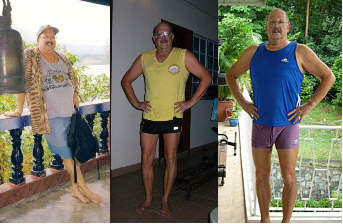
                          I've posted a new pic here this week, as you can see I've radically reshaped & altered my body over the past 6 months while actually staying at the same weight. What I've done then is add lots of lean muscle mass & lose larger amounts of body fat so I'm speaking only in terms of my own personal experience here.

                          Before I started Atkins I swam 1 Mile 5 days a week & that was it which obviously was not enough as I kept gaining weight year by year. In the beginning I followed induction religously & slowly added more exercise & dropped close to 20% of my body weight within the 1st 6 monthes. As my exercise increased so did my carb intake. By the time I hit the end of those 1st six monthes I was up to around 50-60 grams of Atkins OWL type carbs a day & the exercise was getting up to 2 full workouts at least 5 days a week & 1 workout the other 2 days. My workout routines besides swimming now can include on different days these types of things, Running/Walking/Running for long distances, Nordic Track (med/high upper lower body resistance), & Weights lots of free weight reps & some limited heavier lifting once or twice a week.

                          I started to read a lot of the body builder websites & info. I think a lot of the things tried by the body building, gym rat community is pretty radical & even unhealthy stuff over the long term, BUT I find it EXTREMELY interesting. Its amazing how they are able to modify & mold the body through controlled manipulation of the same three key elements as us Atkineerss (Diet, Exercise & Supplements(& in their case sometimes 'drugs)) What you do learn from them is that there is direct 'cause & definable fine tuned effect between your body & very specific combinations of these three key elements.

                          I am someone who has examined sugar alcohol products very carefully being a former diabetic who is not scared to use their glucometer every hour to measure results. I have found that sugar alcohols as advertised DO NOT Increase my blood glucose levels but they do STALL weight loss. I have done a lot of my muscle building exericse routines just after ingesting a 20 Carb/ 3NET Carb(& 17 Phantom Carbs) Sugar Alcohol based protein candy bar & that works for me in terms of workout energy & building muscle mass while continuing to burn & reshape fat.
                          How that one plays out in the science of nutrition is hard to guess, maybe you guys can play with that

                          Most of my carbs now come from huge amounts of Low Glycemic, High Fibre, AntiOxidant Rich Veggies. I'm big on things like Artichoke, Bitter Melon, Eggplant, all kinds of stir fried greens(abundant in Asia) Asparagus, Fresh Bamboo etc I also do regularly eat a limited amounts of fresh berries (all kinds; raspberry, strawberry, blueberry & blackberry) which I can get here albeit at high prices.

                          Another thing I'm big on is a high fibre type of Crisp/Tack call Finn Crisp that I get here in Singapore & in absence of that Wasa Fibre

                          I'm big on Soy, unsweetened soy milk, tofu in many styles & even boiled young green soybeans & I do get a lot of my carbs from nuts including a that non-nut nut the peanut (actually a legume) I estimate nowaday if I do 2 heavy workout sessions I do 6-80 (sometimes even 100 grams of carbs) from these sources a day. I still take in lare amouns of protein from meat & fish & eat lots of eggs too. I keep fat pretty high too

                          Have I 'stalled' ? Yes. but look at the two pictures below essentially the same actual weight, It's quickly obvioud I've radically reshaped & gained lean muscle mass while losing fat & 'tightening' the 'flob' left over from the initial fast losing streak.

                          Whats next. Now I've retightened I plan to drop back on the carbs, keep working out & see if I can start another losing phase.

                          Keep you posted on where that goes...

                          Anybody else that has something to add here please chime in.
                          I try to take one day at a time but sometimes several days attack me at once

                          Started June 1, 2003
                          Start 229/ Now at 188/ Goal 175

                          Straight White Male, Married, 56 Years Old looking for........

                          Comment


                          • #28
                            thanks Skank er shawnee and congrats on the great job you have done adding lean mass while losing body fat. When I first saw the pic I was afraid you were going to post you had gained 20 pounds :yikes but cut your body fat % X amount. whew Glad it was a great Atkins job increasing the lean and decreasing the fat.
                            by the book atkinseer

                            started 6/1/02 at 313
                            goalie 5/04 at 167 with under 15% body fat ADBB Presidents exercise Challenge


                            Comment


                            • #29
                              Naja,

                              Any advice for those of us doing Slow Burn/Super Slow weight training? I'm assuming we would still need a small amount of carbs before a work-out?

                              Many thanks,
                              April

                              Comment


                              • #30
                                Originally posted by Anonymous
                                Naja,

                                Any advice for those of us doing Slow Burn/Super Slow weight training? I'm assuming we would still need a small amount of carbs before a work-out?
                                From the research I've read, super slow contractions don't necessarily give more direct benefit in terms of muscle growth. They may stimulate more lactic acid buildup especially if you do "burns" or partial reps. A reasonably slow, controlled eccentric phase (lowering the weight) is considered a good idea, but it doesn't have to be super slow especially in the concentric (lifting the weight) phase.

                                I don't know whether super slow reps would deplete muscle glycogen more than standard reps. If you research that and find out that it does, then it's probably a very bad choice on a ketogenic diet since you will not be excessively glycogen loading and it really has not been shown to deliver significant benefits.

                                A fairly small amount of carbs (say, half or more of your daily carb allowance) split up 30-40 minutes before and immediately after your workout should do it. Here's a sample plan for someone in the later stages of Atkins.

                                Breakfast: Bacon, eggs, sausage (protein, fat)

                                Snack: Celery with cream cheese, flax crackers

                                Lunch: Roasted chicken, a small salad of lettuce and spinach (protein, fat, some salad vegetables)

                                Light dinner (30-40 minutes before workout) One small slice organic whole wheat bread OR 1/2 a small sweet potato OR 1/2 cup brown rice, 4 oz steamed fish or skinless chicken breast, 1/2 cup steamed broccoli (higher GI carbs, lean protein, vegetable, no fat for more rapid uptake) Looking for 15-30 carbs here. Ladies, eat less. Large gentlemen, eat more.

                                During workout: Water, whey protein, dextrose (optional; only use if your workout lasts more than 60 minutes)

                                Post workout meal: 4 oz lean protein (chicken, fish or nonfat cottage cheese), small portion of carbs (1/4 cup whole wheat pasta, 1 slice whole grain bread, 1/4 cup nonfat plain yogurt). A lot of people can't eat right after working out, so you can also resort to a whey protein shake or tossing some nf cottage cheese, nf yogurt and skim milk into a blender. Again looking for 15-30 carbs here depending on your lean body mass weight.

                                Some people add more carbs here in the form of dextrose or maltodextrin, on the grounds that it will be taken up by the depleted muscle tissue and does not "count" in the sense that it is unlikely to affect ketosis.

                                On Induction it's a little tighter. I'd hit the whey protein pretty hard in an attempt to spare my aminos, and use cooked vegetables as the sole carb sources, 5-10 carbs pre-workout and the same post-workout.

                                Comment

                                Working...
                                X